
By Ellionora Danilova
Published: May 16, 2024
It all started when I decided to participate in the RAISE workshop, a CESIE ETS project that from November 2023 to March 2024 gave me the opportunity to learn how to hold a workshop, based on my passions and talents. During those meetings, CESIE ETS’s team offered me the possibility to follow an online course as a volunteer educator, and once I finished it they supported me in the process of identifying ideas to develop. I decided to propose an origami workshop.
This passion was born by pure chance from the game Tsuki’s Odyssey in which my attention was captured by the Senbazuru curtain made of 1000 origami cranes — a Japanese tradition for the celebration of summer that consists of making 1000 cranes during the year to be able to fulfil a wish at the end. So I tried my hand at this feat and I also started making 1000 cranes during the hours of the day, also to stay awake during lessons. At the end of the year, I realised how this constant work helped me a lot to stay focused in class and distract myself from using my phone.
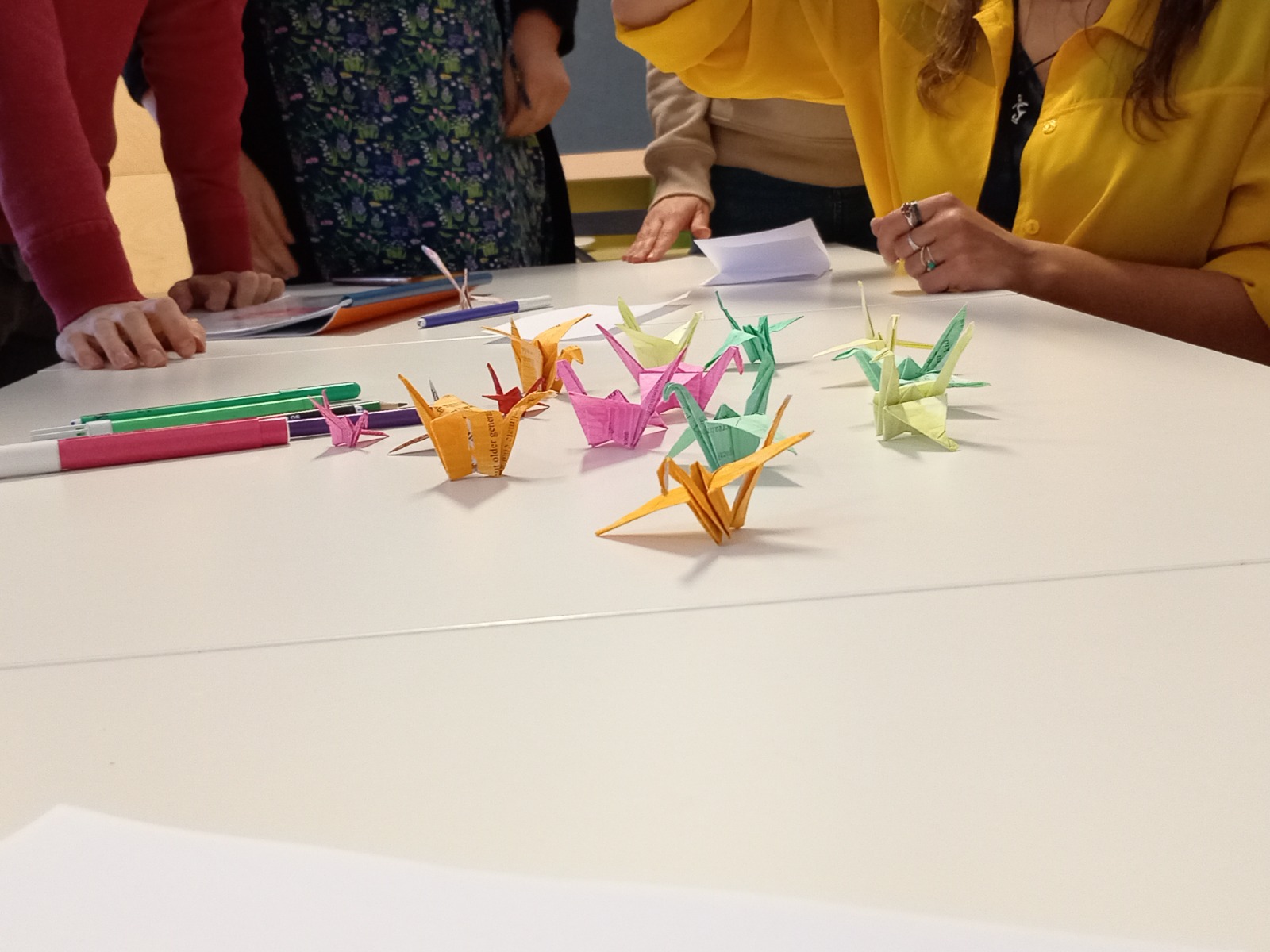
I really enjoyed the first workshop session I conducted, although along the process I felt a lot of anxiety and fear of losing the interest of the participants. It was not easy to mediate between the various groups and at the same time follow individual participants in the realisation of each origami step. I realised that conducting a workshop means sharing, communication and teamwork. You don’t have to do a monologue — you need a lot of collaboration and courage to get involved without fear of the pressure and anxiety that speaking in front of others in a leadership role entails. Thanks to the feedback that participants gave me at the end of the workshop, I understood that engagement can be achieved through the sharing of topics that are valuable and close to the people offering the sessions, rather than long theoretical and technical parts.
In the practical part where everyone tried their hand at making origami, there was very active participation. The theoretical part — when I explained the applications of origami in science, architecture and design — aroused the interest of the teachers more than of other participants. The final feedback gave me the opportunity to better understand how to structure a future workshop.
Yes, I would love to continue teaching other types of origami. For newcomers, I would like to propose the crane workshop again, reducing the theoretical part and dedicating more time to the practical part. I would dedicate a lesson to every single type of origami. An important aspect I would focus on is the usefulness of a daily practice of this type of art — I would talk more about how teachers can use origami in everyday life to improve the psycho-motor skills of children and adolescents. In fact, in Japan it is taught as early as kindergarten. An idea that came out of this workshop and that fills me with enthusiasm is the possibility of creating paper from magazine scraps and using these recycled sheets to make new origami.